State
Navigation: Configuration > General settings > Date & time > State
The State tab displays the current NTP source statistics for the IRF1000. It provides a read-only overview of all configured NTP time sources and their synchronization status, including timing accuracy and reachability information. This view is useful for verifying that time synchronization is functioning correctly and for diagnosing connectivity or accuracy issues with NTP servers. The corresponding NTP settings are configured on the Date & time page.
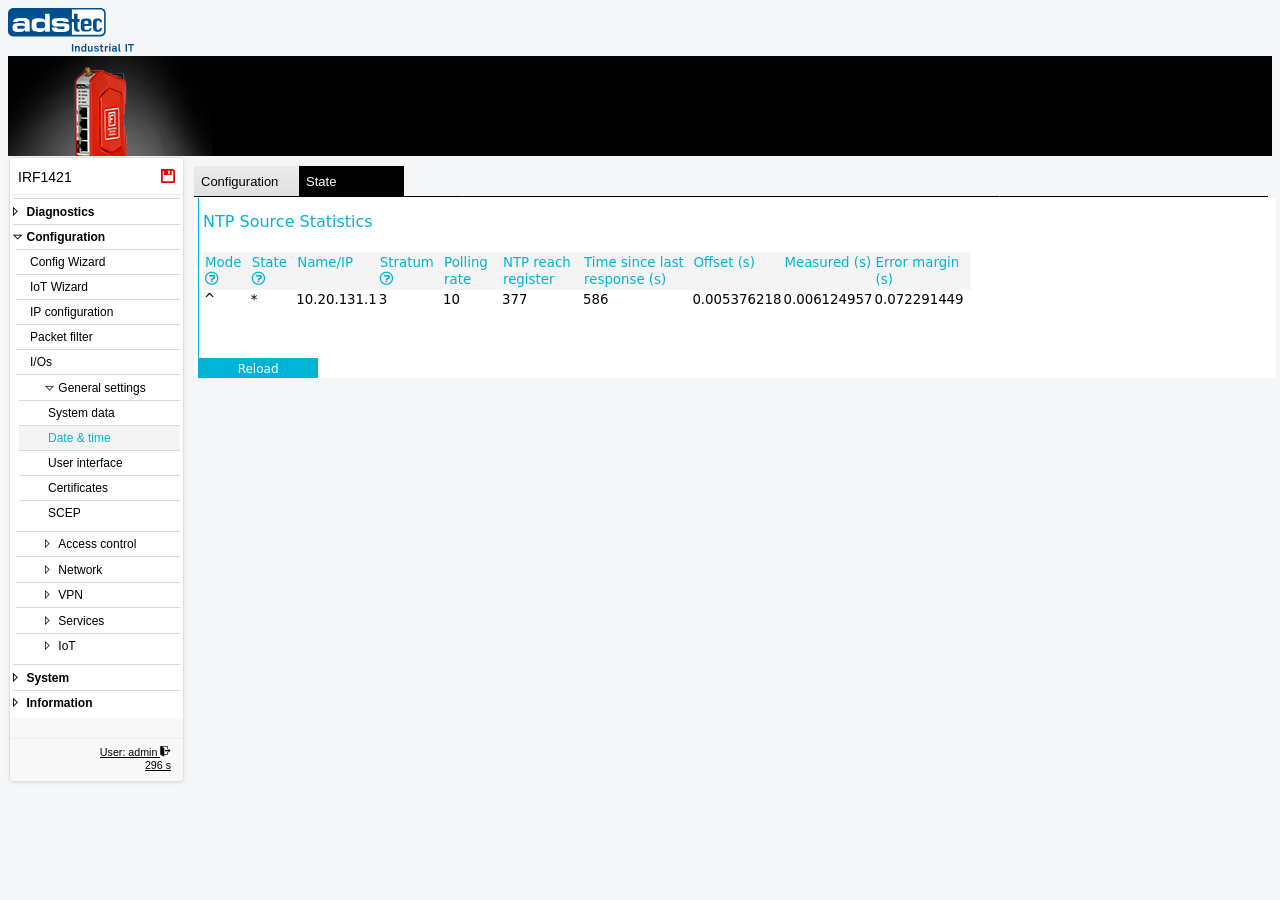
NTP Source Statistics
The table displays one row per configured NTP source with the following columns:
- Mode
- Indicates the type of the NTP source. ^ denotes a server, = denotes a peer, and # indicates a locally connected reference clock.
- State
-
Indicates the synchronization state of this source. The following symbols are used:
- * -- The source to which the device is currently synchronized.
- + -- An acceptable source that is combined with the selected source.
- - -- An acceptable source that is excluded from the combination.
- ? -- A source to which connectivity has been lost. This state is also shown at start-up until at least 3 samples have been gathered from the source.
- x -- A clock that is deemed inconsistent with other sources.
- ~ -- A source whose time appears to have too much variability.
- Name/IP
- The hostname or IP address of the NTP source as configured on the Date & time page.
- Stratum
- The stratum level of the source, ranging from 1 (best) to 16 (worst). Stratum 1 indicates a server directly connected to a reference clock (e.g., GPS or atomic clock). Each additional hop from the reference clock increases the stratum by one.
- Polling rate
- The current polling interval in seconds at which the device queries this NTP source. The NTP client adjusts this value dynamically based on network conditions and clock stability.
- NTP reach register
- An octal representation of the reachability register. This value tracks the success of the last eight polling attempts. A value of 377 (octal) indicates that all eight most recent attempts were successful.
- Time since last response (s)
- The number of seconds elapsed since the last valid NTP response was received from this source.
- Offset (s)
- The estimated offset in seconds between the local clock and this NTP source. A negative value indicates that the local clock is ahead of the source; a positive value indicates it is behind.
- Measured (s)
- The raw measured time difference in seconds from the most recent sample obtained from this source.
- Error margin (s)
- The estimated error margin in seconds for the measurements from this source. A smaller value indicates higher confidence in the accuracy of the time synchronization.
Click Reload to refresh the NTP source statistics with the latest values from the system.