GPS service
Navigation: Configuration > Services > GPS service
The GPS service page enables the on-board GPS distribution service (gpsd) on the IRF3000. When enabled, the device starts a gpsd-compatible TCP server on port 2947 that distributes the NMEA GPS/GNSS signal from the cellular modem over the network, so that gpsd-compatible clients can read the device's position and time. The Access to GPSD Service table controls on which interfaces the service accepts connections. The live GNSS status is shown on the State tab. Changes take effect after clicking Apply, but must be saved persistently via the Save page to survive a reboot.
Note
The GPS service requires a device equipped with a cellular (WWAN) modem, which provides the GNSS receiver. A GPS antenna with sky visibility is required for a position fix.
NTP time source
The GPS signal can also serve as a local time source: the device's NTP server can take its time from the GPS receiver and distribute it to the local network. Configure this on the Date & time page.
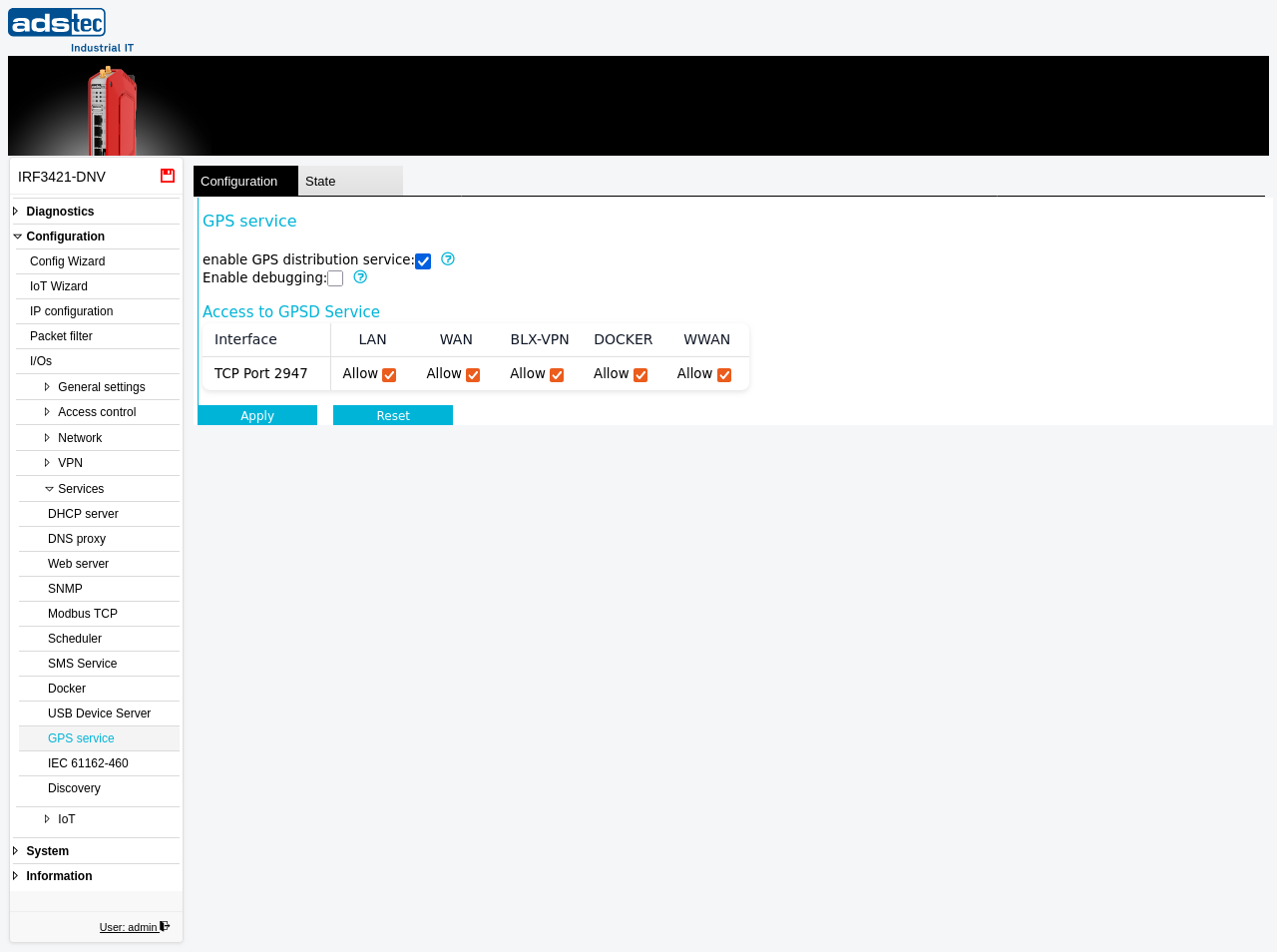
Settings
- Enable GPS distribution service
- Enables the gpsd service on the device. This starts a TCP server on port 2947 that listens for gpsd-compatible clients and distributes an NMEA-compatible GPS signal from the device's modem over the network. See the gpsd project documentation for the gpsd protocol and client API.
- Enable debugging
- When enabled, all NMEA data is additionally logged to the Eventlog.
Access to GPSD Service
The access table controls on which network interfaces the GPSD service (TCP port 2947) accepts incoming connections. Each interface can be set to Allow independently.
LAN: Allows access from the local network.
WAN: Allows access from the wide area network.
BLX-VPN: Allows access through a Big-LinX VPN tunnel.
DOCKER: Allows access from Docker containers running on the device.
WWAN: Allows access from the wireless WAN (cellular) interface.
Security
Only enable the GPS service if network access to the position data is required, and restrict it to trusted interfaces. The gpsd protocol on TCP port 2947 is unauthenticated, so block access on the WAN and WWAN interfaces unless explicitly needed.